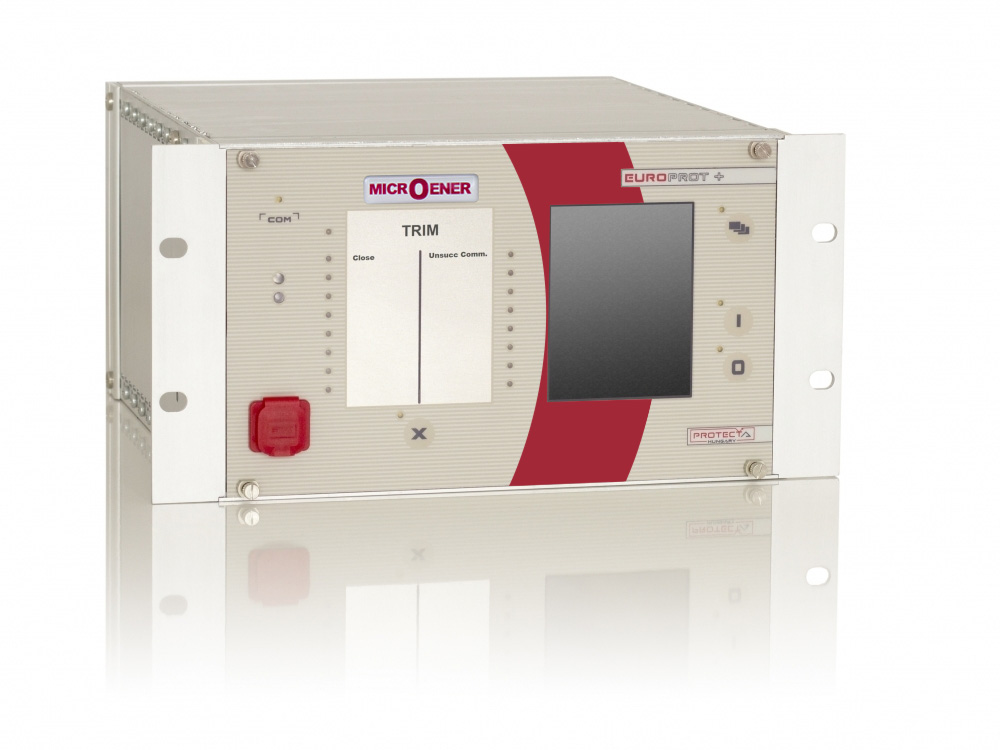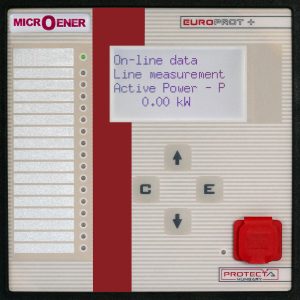

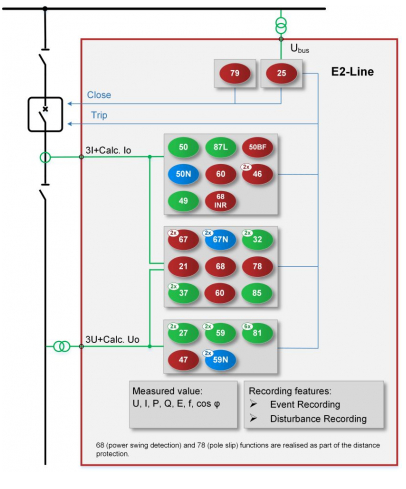
Functional block diagram of the DTVA/Di relay
General presentation
The DTVA/Di relay is an intelligent electronic device (IED) dedicated to the protection, control and automation of transmission overhead lines and cables. This relay offers complex protection, control and monitoring functions. It belongs to the DTVA product family within the PROTECTA product range. Thanks to a modular architecture, the modules are assembled and configured according to the user’s needs; from then on, the software determines the functions (SFB).
The DTVA product family is configured to protect, control and supervise transmission network components, where systems are generally solidly earthed worldwide. In these networks, single-phase earth faults generate high currents, similar to those of phase-to-phase faults; both types of fault therefore require fast protection functions.
The relay can be used for single-phase or three-phase tripping and supports two-circuit-breaker schemes, such as breaker-and-a-half or ring bus topologies.
The main functions of the DTVA protections include a fast distance protection with five independent protection zones and a line differential protection. The relays support the general teleprotection schemes (POTT, PUTT, etc.).
In addition, the DTVA protections include a variety of versatile protection functions: directional and non-directional overcurrent protection, voltage-based protection and frequency-based protection.
The HV auto-reclosing function allows multi-shot auto-reclosing with a synchronism check function. Dead times can be set individually for each reclosing attempt and separately for single-phase and multi-phase faults.
Thanks to its built-in control, measurement and monitoring functions, the IED can also be used as a bay control unit.
The EuroCAP configuration software, available free of charge, provides a user-friendly and flexible application for protection, control and measurement functions, allowing the use of fully customisable devices.
General features
- Native intelligent electronic device (IED) compliant with the IEC 61850 standard, Edition 2 compatible
- Scalable hardware adapting to different applications
- Rack width of 84TE or 42TE (height: 3U)
- The predefined factory configuration can be customised to the user’s specifications with the powerful EuroCAP tool
- Flexible protection and control functionalities to meet specific user requirements
- Advanced HMI functionalities via a colour touch screen and a built-in web server, extended measurement, control and monitoring functions
- User-configurable LCD displays, able to show single line diagrams (SLD) with switchgear position indication and control, as well as measurement values and several types of controllable objects.
- Various protection setting groups available
- Enhanced circuit breaker monitoring and control
- High-capacity disturbance recorder (DRE) and event logging (data stored in non-volatile memory):
- DRE supporting up to 32 analogue signal channels and 64 digital signal channels.
- The event recorder can store more than 10,000 events.
- Several mounting methods: rack-mounted; flush-mounted; semi-flush-mounted; wall-mounted; wall-mounted with terminals; flush-mounted with IP54-rated cover.
- Wide range of communication protocols
- Ethernet communication: IEC 61850; IEC 60870-5-104; DNP3.0 TCP; Modbus TCP
- Serial communication: DNP3.0; IEC 60870-5-101/103; MODBUS, SPA
- The PROTECTA range can handle several communication protocols simultaneously.
- Built-in self-monitoring function to detect internal hardware or software errors.
- Various time sources available: NTP server; minute pulse; legacy protocol master; IRIG-B000 or IRIG-B12X
Applications
The DTVA/Di protection is an intelligent electronic device (IED) for protection and control combining line differential protection and distance protection. It is dedicated to transmission networks; this relay offers complex protection, control and monitoring functions.
The phase-segregated DTVA/Di allows fast selective tripping per phase, depending on the faults and the requirements. Current transformer (CT) error detection, CT saturation detection and optional charging current compensation are integrated in the configuration in order to improve stability and sensitivity. It can be used on multi-terminal lines with a maximum of three line ends.
Distance protection is also included in the configuration; it can serve as back-up protection in the event of a communication failure, or as a second main protection function.
The DTVA/Di relay integrates a varied range of versatile protection functions, such as current- and voltage-based functions, the directional extension of the configured phase and residual overcurrent functions, as well as directional overpower or underpower functions. This range of functions is completed by the auto-reclosing function, the synchrocheck, power swing detection and switch-on-to-fault logic (SOTF). Frequency is also evaluated from the voltage measurement in order to implement frequency-based protection functions.
The DTVA/Di relay can be used as a back-up protection unit or as a decentralised busbar protection subunit.
Field of application
- The main application is the protection of transmission overhead lines and underground cables (including series-compensated lines)
- The main protection is a phase-selective line differential protection.
- Redundant communication over two physical links at both ends
- Support for three-terminal topology
- Detection of current transformer (CT) errors and saturation,
- Optional capacitive charging current compensation,
- Wide range of supported communication schemes: dedicated optical fibre channel, pilot wire, communication networks using the G703.1 standard (64 kbit/s)
- The transformer can be placed inside the protected zone
- Single-phase or three-phase tripping and support for two-circuit-breaker schemes, such as breaker-and-a-half or ring bus topologies.
- Five independent distance protection zones with polygonal or MHO characteristics
- Load encroachment characteristics
- The complex earth fault compensation factor is applied for the correct impedance measurement of single-phase earth faults
- Non-directional impedance protection function or fast OC protection function for switch-on-to-fault conditions (SOTF)
- The power swing detection function can block the distance protection function during stable swings, or generate a tripping command if the network loses synchronism
- Analogue input processing is applied to the zero sequence current of the parallel line
- Single-phase or three-phase tripping and support for two-circuit-breaker schemes, such as breaker-and-a-half or ring bus topologies
- Transmission of logic signals
- Numerous teleprotection tripping schemes available (PUTT, POTT, DUTT, directional comparison or blocking, etc.)
- Current reversal and weak infeed logic
- Auto-reclosing with up to four attempts; dead times can be set individually for each reclosing sequence and separately for single-phase and multi-phase faults
- Full faulted phase identification through underimpedance detection
- Voltage transformer (VT) supervision and dead line detection
- CT current unbalance detection
- Switchgear automation and control with synchrocheck functionality
- Programmable closing schemes
- Back-up protection for transformers, lines, generators, motors and busbars
- Optional application of a decentralised busbar protection subsystem
Protection and control functions
The particularity of the DTVA/Di protection is that it has two main protection functions: the distance protection function and the line differential protection function.
In this configuration the protection measures the three phase currents, the zero sequence current component of the parallel line, as well as the three phase voltages and the busbar voltage. In addition to the current- and voltage-based functions, these measurements allow the directional extension of the phase and residual overcurrent functions, as well as directional overpower or underpower functions. The communication board sends and receives phase current vectors in order to implement the line differential protection function.
Frequency is also evaluated from the voltage measurement in order to support frequency-based protection functions.
Click on the link to download the general documentation : Please contact our Sales Department
Click on the link to download the technical sheet : Please contact our Sales Department
Click on the link to download the operation manual : Please contact our Sales Department
Click on the link to access the technical documentation to attach to your order : DOCACOM_PROTECTA